



City Health Office head Dr. Ashley Lopez said the outbreak started July 15 after several residents had experienced loose bowel movement (LBM) and vomiting.
Several admissions at the private hospitals were also recorded on Saturday, July 16, according to Lopez.
“This is the time when our sanitary inspectors and district surveillance officers conducted an investigation in Toril areas. Just yesterday (Sunday) they were able to confirm that there is really an outbreak based on the number of admissions particularly in three private hospitals,” Lopez said in an interview over Davao City Disaster Radio on Monday, July 18.
He said several patients have been admitted at Saint John Hospital, Mediquest Hospital and Malta Hospital. All are located in Toril District.
According to him, based on the initial investigation, the outbreak could be due to water contamination or it could be food poisoning.
“It can be contaminated water which is brought about by rains, there are also areas where flooding continues or probably contamination from potable water,” Lopez said.
Lopez said it was reported by sanitary inspectors and surveillance officers that there are street foods and tapioca sold along the streets of Toril which can also be a possible source of infection.
“We are already conducting rectal swab and water analysis including fecal analysis to those patients admitted in the hospitals. These specimens will be submitted at the Southern Philippines Medical Center (SPMC) for analysis to determine what causes the infection.
Those barangays affected by the outbreak are Barangays Bato,Toril Proper, Lubugan, Crossing Bayabas, Mulig, Daliaon Plantation, and Tungkalan.
Other villages include Daliao North, Dalia South, Lizada Fish Port, Lizada Curbada, and Barangay Binugao.
The Davao City Water District (DCWD) earlier assured its customers that their water sources are safe.
They said DCWD immediately double-checked all of its water sources in the affected areas following the information on the high LBM cases from Matina to Toril areas.
DCWD said all their chlorination facilities are working 100% with chlorine residual within the normal limits (0.8 ppm).
This residual is enough to inactivate bacteria causing waterborne diseases such as diarrhea.
“In addition, DCWD is now conducting extensive water sampling and testing in its water distribution network serving the affected areas,” the statement said.
The water utility firm further said that DCWD has protocols in place to ensure that the
quality of water it provides to the customers passes the parameters of the Philippine National Standards for Drinking Water (PNSDW).
It maintains the use of gas chlorine in controlled dosage to treat the water and ensure it is safe for consumption.
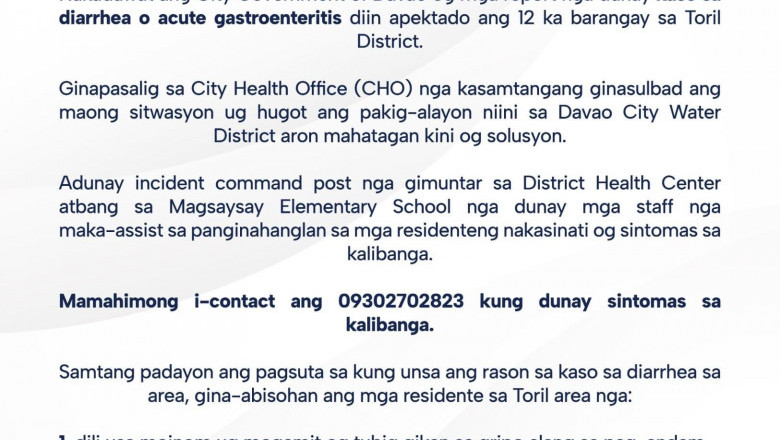
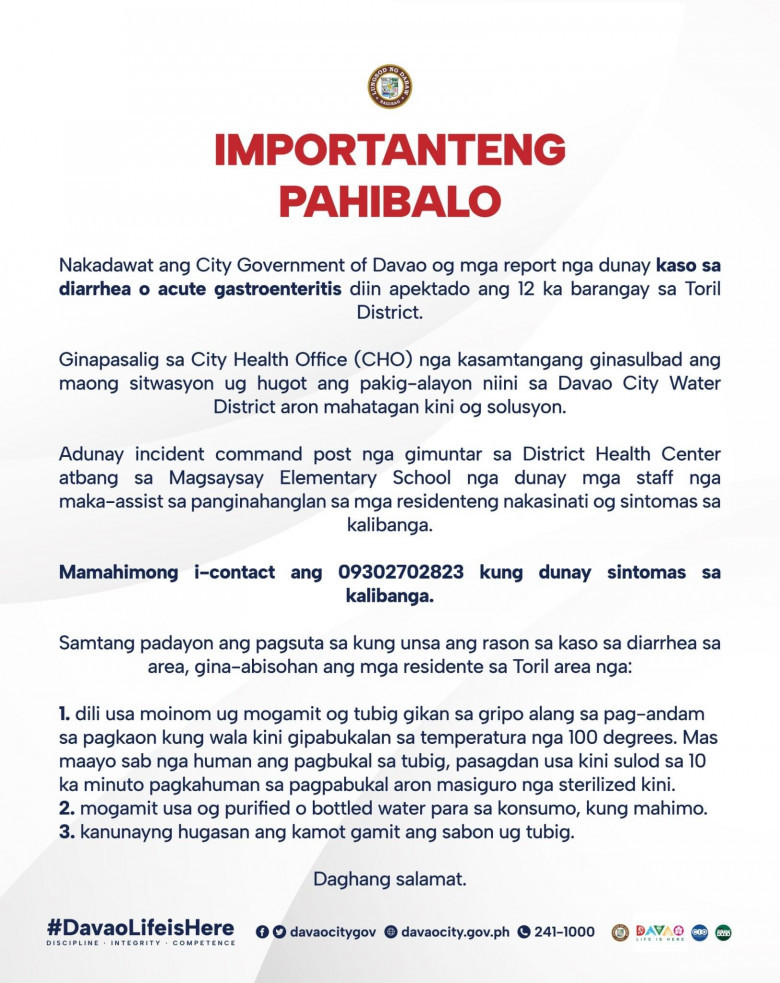
The residents of Toril District were advised to boil their water before consumption following the suspected water contamination in said area.
Lopez, meanwhile added that based on the instruction of Mayor Baste Duterte, they have coordinated with Lingap Para sa Mahirap for assistance in the hospitalization of indigent individuals.
“The City Government of Davao is ready and open for any assistance to citizens affected by the diarrhea outbreak,” Lopez said.









Facebook Conversations