


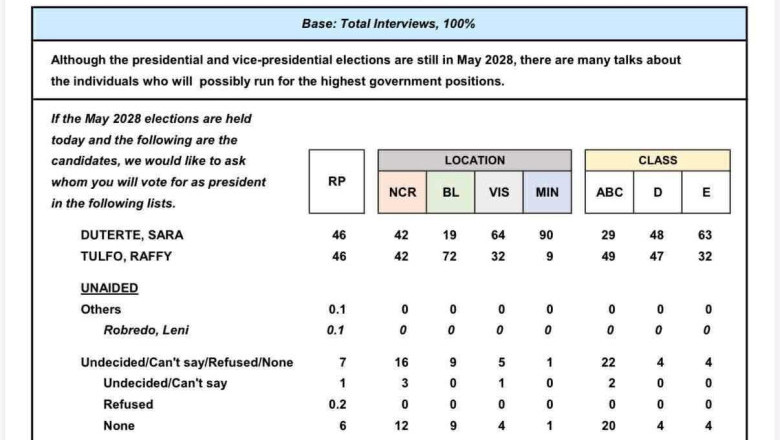

However, the result comes with a crucial limitation: the survey question presented only two main names—Duterte and Tulfo—to respondents.
It did not include other widely discussed potential contenders such as former Vice President Leni Robredo, Senator Risa Hontiveros, Senator Bam Aquino, DILG Sec. Jonvic Remulla, and others.
This framing effectively turns the exercise into a head-to-head preference test, rather than a full multi-candidate simulation of the 2028 race.
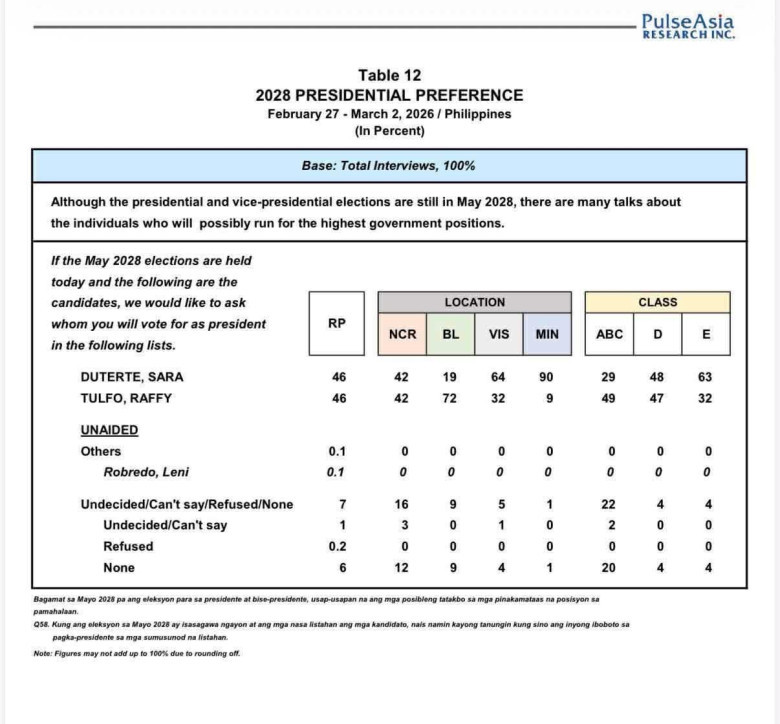
Even within that limited choice set, the data reveals sharp regional polarization. Mindanao is where Duterte overwhelmingly leads with 90%, compared to Tulfo’s 9%.
Visayas is still for Duterte who maintains a strong edge at 64% vs Tulfo’s 32%. While in Balance Luzon, Tulfo dominates with 72%, while Duterte gets 19%. In NCR, the two are tied at 42% each.
The numbers reflect entrenched regional bases, with Duterte dominant in the Visayas and Mindanao, and Tulfo leading in Luzon outside Metro Manila.
Socioeconomic breakdowns further highlight contrasting voter coalitions wherein Duterte leads with 63%, Tulfo at 32% at Class E. In Class D, it's a nearly even fight with Duterte 48%, and Tulfo 47%.
In Class ABC, Tulfo leads with 49%, Duterte at 29%.
This suggests Duterte continues to resonate strongly with lower-income voters, while Tulfo performs better among higher-income groups.
ABSENCE OF OTHER CANDIDATES MATTERS
Although the table lists minimal percentages for “others,” these figures are not reflective of a true multi-candidate race.
Analysts note that excluding other viable or frequently mentioned presidentiables—such as Robredo, Hontiveros, Aquino, and Remulla—can significantly affect how respondents distribute their preferences.
“In surveys like this, the structure of the question shapes the outcome,” one observer noted. “A two-name prompt measures comparative strength between those two—but it does not capture the full competitive field.”
With the 2028 elections still more than two years away, the survey should be viewed as an early snapshot of political positioning rather than a definitive forecast.
About 7 percent of respondents remain undecided or declined to answer, and voter sentiment is expected to shift as more candidates formally emerge and national issues evolve.
For now, the poll underscores a developing narrative: a Duterte–Tulfo rivalry defined by regional strongholds and class divisions—but one that remains incomplete without the inclusion of the broader field of potential contenders.






Facebook Conversations